Waste to Wonder Park In New Delhi
Waste
to Wonder Park
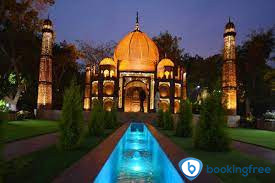
Waste to Wonder Park is made of modern and different other waste materials,
and it will surely leave you puzzled with amazement. Lodging the simulations of
the seven traditional miracles of the world, this is one of the popular
attractions in Delhi. If you are pondering where you can take your children for
some improvement, then, at that point, do visit the Waste to Wonder Park, as it
is one of the most amazing spots to visit in north Delhi.
The
Statue of Liberty, the Eiffel Tower, the Colosseum, and India's own personal
Taj Mahal, alongside different miracles, are stunningly worked out of lines,
metallic sheets, scrap points, and various other waste materials. The
recreation area altogether worked with the rationale of moderating the climate,
such as utilizing sun based and wind energy for the end goal of lighting during
the night. Partake in the illusory setting and save your cameras prepared for a
few captivating pictures.
Passage
Timings-11 am every day. Shut on Monday.
Passage
Fee-Rs 50 for grown-ups and Rs 25 for ured betw and en 3-12 old years.
Near
Nizammudin Metro station, Block A, Nagli Rajapur, Sarai Kale Khan, New Delhi.
Insider
Tips: If you desire to keep
away from the multitude of guests, then, at that point, do visit the recreation
area on work days. Since there is no food slows down accessible inside, make
sure to convey your rewards and water. The spot likewise charges an extra
stopping expense.
Jantar
Mantar
Among
the five significant Jantar Mantar developed by Maharaja Jai Singh II of Jaipur, one in
which Delhi has an equivalent standing as the Jaipur. At Delhi Jantar Mantar, there are 13 designed stargazing instruments. It is one
of the most visited vacationer places in Delhi in the summers, and it was
planned to aggregate the cosmic tables and to foresee the development and timings
of the sun, the moon, and the planets. Arranged on Parliament Street, south of
Connaught Circus in New Delhi, the Observatory has stone work constructed
cosmic instruments.
Because
of the limitless longing of Maharaja Jai Singh II to invest energy in the
galactic perceptions and to concentrate on the frameworks, the Observatory was
raised without help from anyone else. The name of the Observatory gives us an
implication that it is the instrument for computation. The tools safeguarded in
the Observatory were made of block rubbles and afterward put with lime. As time
advanced, the devices underwent a few fixes and rebuilding. However,
significant changes were a long way from them.
The
Samrat Yantra, the Jai Prakash, Ram Yantra, and Misra Yantra are the chief
instruments saved in the Observatory. A sanctuary devoted to Bhairava is close
to the structure in which Maharaja Jai Singh II worked. The Jantar Mantar in
Delhi had its development begin in 1724. It appeared in 1724, yet by 1867, the
Observatory had confronted many rots. After the development of the Jantar
Mantar in Delhi, Maharaja Jai Singh II fabricated more observatories in Jaipur,
Ujjain, Varanasi, and Mathura.
Jantar
Mantar passage timings:
The
Observatory is open on entire days from 09:00 am to 07:00 pm.
Jantar
Mantar section charge:
To
enter the Observatory, Indian residents must pay INR 5, and outdoor nationals
must pay INR 100.
Jantar
Mantar area:
Sansad
Marg, Connaught Place, New Delhi, Delhi 110001.
What is Nearby
| Nearby | Distance |
|---|---|
| New Delhi | 9 Km |
| South West Delhi | 28 Km |
| North West Delhi | 34 Km |
| South Delhi | 19 Km |
| Hazrat Nizamuddin Metro Station | 300 m |
| New Delhi Railway Station | 11 Km |
| Indira Gandhi International Airport | 16 Km |
| Safdarjung Airport | 8 Km |
